24x7 Customer Support


Copyright
©
2026 byteeIT. All rights reserved.
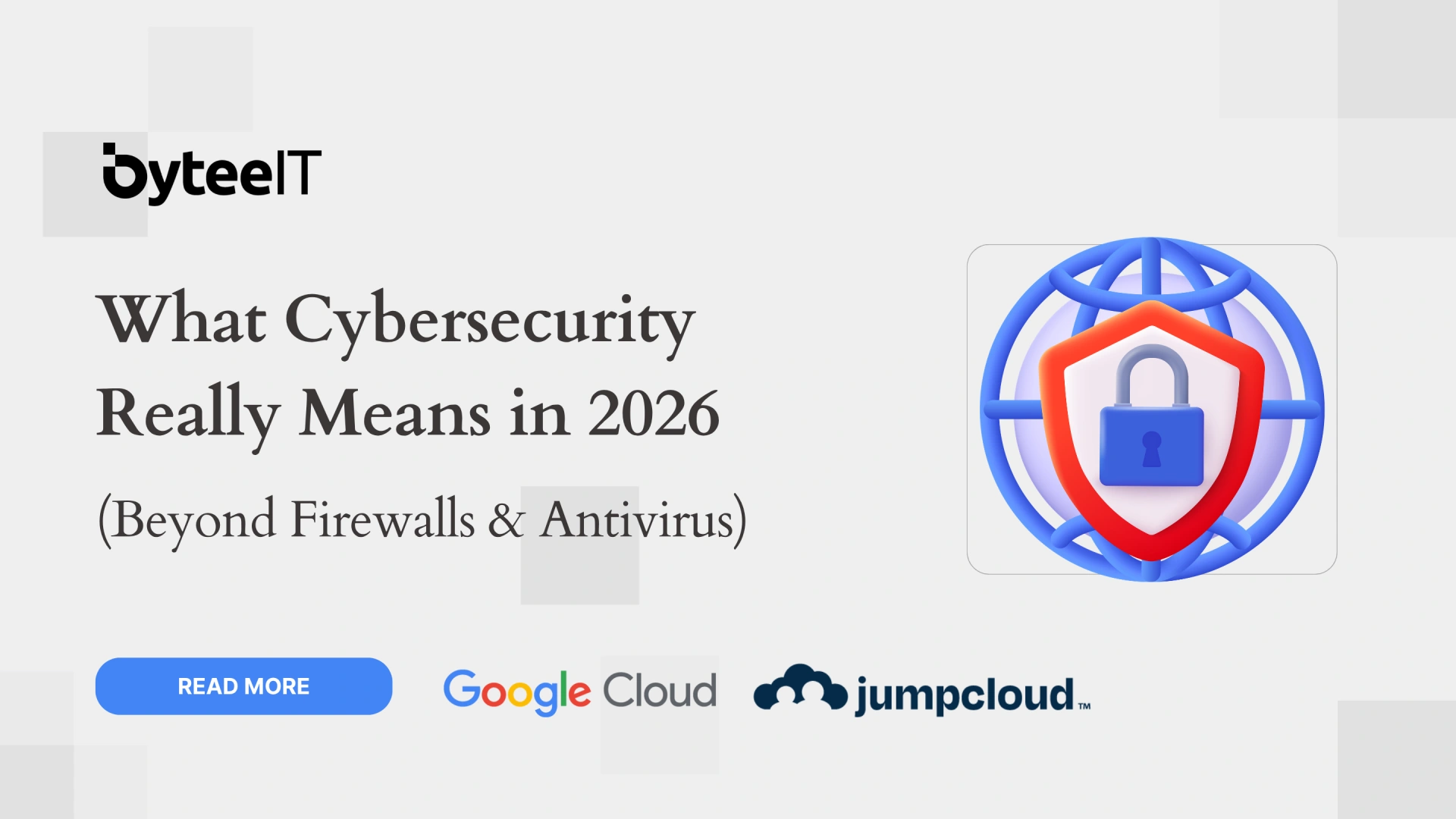
For decades, we treated
cybersecurity
like a medieval engineering project. We built higher walls, dug deeper
moats, and assumed that if we could just keep the "outside" world at bay,
our data remained a sanctuary. But as we sit here in 2026, the tech leaders
in Riyadh, Dubai, and Mumbai are waking up to a different reality: the walls
haven't just been breached—they’ve become irrelevant.
Cybersecurity
has transitioned from a technical checkbox to a deeply human challenge. It
is no longer just about the software we install, but the digital trust we
cultivate. With the GCC cybersecurity market surging toward $6.3 billion
this year, we are seeing a massive shift in capital toward one goal: digital
resilience.
In an era of autonomous AI threats and dissolved
boundaries, our defense must be as fluid and adaptive as the humans it
protects. Here is what cybersecurity actually looks like in 2026 and how
enterprises can move beyond the legacy mindset to achieve true resilience.
Cybersecurity in 2026 is an identity-first, AI-driven approach to protecting systems, where threats are automated and defenses rely on Zero Trust, behavioral analytics, and cloud-native security—not traditional firewalls.
Zero Trust is a security model that assumes no user or device is trusted by default and requires continuous verification based on identity, behavior, and context.
AI cybersecurity threats are automated attacks that use artificial intelligence to generate phishing, deepfakes, and adaptive malware that can bypass traditional defenses.
Firewalls are no longer sufficient because modern attacks occur inside the network using stolen identities, making perimeter-based security ineffective.
If 2024 was the year of AI experimentation, 2026 may as well turn out to be
the year of AI-weaponization. According to the World Economic Forum’s Global
Cybersecurity Outlook 2026, a staggering 94% of leaders now cite AI as the
primary driver of change in the threat landscape.
Attackers are
no longer manually crafting phishing emails; they are using autonomous AI
agents to conduct reconnaissance and execute "living off the land" attacks
at machine speed. These agents can mimic a CEO's voice in real-time or
bypass biometric authentication using high-fidelity deepfakes.
The shift: Defense must also become autonomous. We are moving toward AI-native
security operations centers (SOCs) that can predict and neutralize threats
before a human analyst even receives an alert. In this environment, a
firewall is merely a screen door; your real defense lies in behavioral AI
models that detect anomalies in data flow and user intent.
In 2026, "Identity" has officially replaced the network as the primary
battleground. Adversaries have shifted from breaking in to simply logging
in.
Traditional password-based systems are obsolete. The focus
has pivoted sharply toward Zero Trust Architecture (ZTA). The core
philosophy? Never trust, always verify. Every access request, whether it
comes from a remote developer in Bengaluru or a C-suite executive in Dubai,
must be continuously authenticated based on device health, location, and
behavioral context.
To stay ahead, organizations are turning to
unified platforms. This is where ByteeIT steps in. As a JumpCloud Gold
Partner, ByteeIT helps startups and enterprises consolidate disparate
identity silos into a single, secure control plane. By leveraging
JumpCloud’s open directory platform, ByteeIT ensures that every
identity—whether human or a non-human AI agent—is strictly governed and
every device is verified before gaining access to critical resources.
The geographical context for cybersecurity in 2026 is unique for entities in the Middle East. The GCC region remains a prime target for sophisticated state-sponsored actors. In the UAE, public sector organizations are currently defending against an estimated 50,000 cyberattacks per day. The focus here has shifted toward cyber sovereignty and protecting the critical infrastructure that underpins the region’s ambitious Vision 2030 goals.
Today, your security is only as strong as your weakest vendor. Supply chain
attacks have become the preferred method for reaching hardened targets.
Whether it is a vulnerability in an open-source library or a compromised
third-party SaaS tool, the ripple effects can be catastrophic.
Across
the industrial hubs of the GCC—from smart power grids in Saudi Arabia to
automated ports in the UAE—every valve, turbine, and robotic arm is now
connected to the internet. This convergence has changed the stakes of a data
breach. We are no longer just talking about stolen spreadsheets or leaked
emails; we are talking about physical consequences. A cyberattack today can
physically overheat a server room, shut down a water desalination plant, or
halt a production line in real-time. This is the reality of the Internet of
Everything (IoE): when everything is connected, everything is vulnerable.
Future-proofing in 2026 isn't about buying more tools; it's about
integration and orchestration. Adding more point solutions only creates
security fatigue and blind spots.
ByteeIT is a
Google Premier
Partner in UAE that specializes in helping organizations move away from
legacy infrastructure that lacks the agility to face modern threats. By
integrating the power of Google Threat Intelligent with the granular device
and identity management of
JumpCloud , we can facilitate a cybersecurity transformation set that is both highly
secure and user-friendly. Our expertise allows enterprises to retire
outdated directories and transition to a cloud-native, AI-first security
posture that meets the rigorous demands of today.
The cybersecurity landscape of 2026 is no longer about building higher
walls; it is about building resilient systems that assume breach, verify
identity relentlessly, and leverage AI to fight AI. For IT professionals in
the GCC, the path forward involves a radical simplification of the tech
stack and a shift toward identity-centric security.
As we move toward a world of autonomous agents and hyper-connected cities,
we must ask ourselves: in an age where AI can mimic any voice and bypass any
perimeter, what remains as our ultimate source of digital truth?
Cybersecurity in 2026 is about verifying identity, using AI to fight AI, and building systems that assume breaches rather than trying to prevent them entirely.
Zero Trust is more effective because it continuously verifies every user and device, unlike firewalls that trust users inside the network. This reduces risks from stolen credentials and insider threats.
AI is used by hackers to automate reconnaissance, generate hyper-realistic phishing (Deepfakes), and create malware that evolves to bypass traditional signature-based antivirus. Attackers now move at "machine speed," requiring defenders to use AI-driven tools like XDR (Extended Detection and Response).
GCC enterprises are focusing on cyber sovereignty, threat intelligence sharing, and securing Critical Information Infrastructure (CII). Moving to cloud-native platforms with high-level certifications, such as those provided by Google Cloud, helps ensure data remains secure and localized.
A JumpCloud Gold Partner like ByteeIT provides expert implementation of unified identity, access, and device management. This allows your business to eliminate legacy hardware, secure a distributed workforce, and ensure only verified users access sensitive data.
As a Google Premier Partner, ByteeIT has direct access to Google Cloud’s world-class security infrastructure and advanced AI tools. This ensures that enterprises can leverage the most current security patches, threat telemetry, and cloud-native defense mechanisms available.