CRM platforms are essential for managing customer relationships, tracking
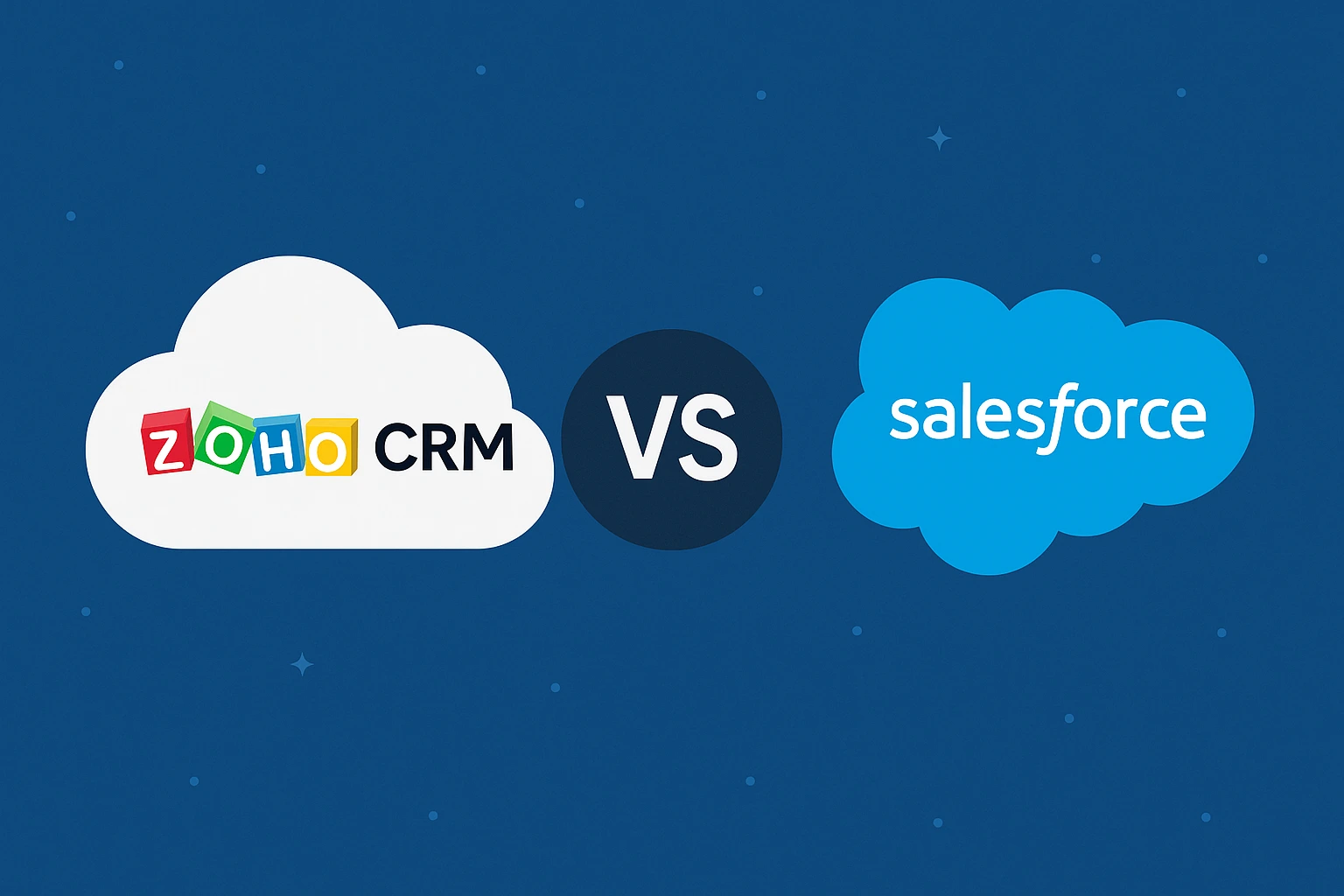
sales, and driving growth. Zoho CRM and Salesforce are both
leaders, but they serve different priorities. By understanding in detail the
factors that distinguish the two, businesses can make an informed decision
on the best fit for their purposes. Here is an overview.
Zoho CRM vs Salesforce — Key Comparisons
1. Pricing
-
• Zoho CRM: Highly competitive. Paid plans start low, and even the
Enterprise tier remains a fraction of Salesforce’s cost—often up to 85%
less.
-
• Salesforce: Premium pricing. Enterprise-grade plans can become
costly once you add extra modules, storage, and advanced features.
Takeaway:
Zoho
wins on cost predictability and accessibility for
SMBs; Salesforce is a long-term investment for complex enterprises.
2. Ease of Use
-
• Zoho CRM: Minimal learning curve. The interface is intuitive,
with easy-to-use customization tools like Canvas for designing bespoke
layouts.
-
• Salesforce: Rich in features but more complex to navigate; often
requires onboarding sessions or certified admin support.
Takeaway:
Zoho
gets teams productive faster; Salesforce requires more
upfront training but offers depth for power users.
3. Feature Depth
-
• Zoho CRM: Offers everything most sales teams need—lead and deal
management, pipeline tracking, workflow automation, multichannel
engagement, reporting, and AI-powered assistance through Zia.
-
• Salesforce: Goes deeper in advanced forecasting, territory
management, AI analytics (Einstein), and enterprise-grade workflow
orchestration.
Takeaway:
Zoho
covers 80–90% of typical CRM requirements at a lower
cost. Salesforce shines in hyper-customized, large-scale deployments.
4. Integration & Ecosystem
-
• Zoho CRM: Seamless integration with over 40 other
Zoho
applications (Zoho Books, Zoho Desk, Zoho Campaigns, etc.) and hundreds of
third-party tools via APIs.
-
• Salesforce: Massive AppExchange marketplace with thousands of
integrations, but some require premium connectors or custom development.
Takeaway:
Zoho
offers a tightly integrated ecosystem for all-in-one
business management; Salesforce provides breadth for specialized enterprise
needs.
5. Strengths & Weaknesses
Zoho CRM
Strengths
-
• Affordable pricing with rich functionality.
-
• User-friendly interface with drag-and-drop customization.
-
• A user-friendly, secure platform that protects your data and scales with
you
-
• Native integration with over 40 other
Zoho
apps.
- • AI-powered automation via Zia.
Weaknesses
-
• May lack some advanced enterprise-grade features of Salesforce.
-
• Smaller third-party integration marketplace than Salesforce.
-
• Customization for highly complex workflows can require more dev work.
Salesforce
Strengths
-
• Extremely powerful for large, multi-departmental enterprises.
-
• Vast AppExchange marketplace and partner network.
-
• Advanced AI, forecasting, and customization tools.
Weaknesses
-
• High cost of ownership, especially for SMBs.
- • Steeper learning curve for new users.
-
• Implementation and customization often require certified specialists.
ByteeIT: Your Zoho Partner
As an official Zoho Partner, ByteeITensures Zoho CRM fits your exact
sales process—with proper setup, automation, integration, and ongoing
optimization. With experience in setting up
Zoho
across different
organisational sizes, industries and workflow styles, ByteeIT has the
capabilities to help you draw out maximum value from your Zoho CRM setup.
Verdict
Zoho CRM is the practical, cost-effective choice for SMBs needing powerful
features without enterprise-level costs. Salesforce remains the powerhouse
for large-scale, complex CRM needs.
FAQs
Q1: Is Zoho CRM suitable for large enterprises?
Yes, but it’s especially suited for SMBs.
Q2: Does Zoho CRM have AI features?
Yes—Zia AI offers predictions, scoring, and workflow suggestions.
Q3: Can Zoho CRM integrate with my ERP?
Yes, via APIs and third-party connectors.
Q4: How does ByteeIT ensure CRM success?
We configure
Zoho
CRM to your sales process, train users, and support
scaling.